Genetic Testing & Gene Expression Profiling
Genetic testing allows us to test a person’s blood to see if they carry a mutation in their genes which puts them and their family at higher risk for melanoma skin cancer.
Approximately 10% of all melanomas are caused by a genetic mutation in a person’s genome. The most commonly tested mutation is CDKN2A. If you have this mutation, you carry about a 40% chance of developing a melanoma skin cancer.
-
Sometimes it can be difficult to diagnoses melanoma based on the pathology results alone.
CGH (Comparative Genetic Hybridization) and Fluorescence In Situ Hybridization (FISH) are genetic tests that can be performed on a melanoma tumor to help make the correct diagnosis.
Sixty four percent of melanomas lose a part of their DNA located at the 9p location; while 37% of melanomas gain DNA at the 6p part of their DNA.
Looking for these extra or lost copies of DNA can help to tell melanoma apart from a mole.
These tests can be performed by specialty laboratories and must be ordered by a physician. It may be reasonable to order this extra testing if your diagnosis is in question.
A diagnosis may be in question especially when it is diagnosed in a child or even a young adult. One of the procedures used to stage a melanoma involves checking the lymph nodes for spread of the melanoma (sentinel lymph node biopsy). This procedure is safe, but patients can have complications including infection, delayed healing, and permanent lymphedema or swelling of a limb. For these reasons, we would want to avoid this procedure in a child or young adult unless absolutely necessary.
-
Gene Expression Profiling is a test that looks at the genes expressed by a melanoma. The test generates a score which can separate melanoma from harmless moles.
-
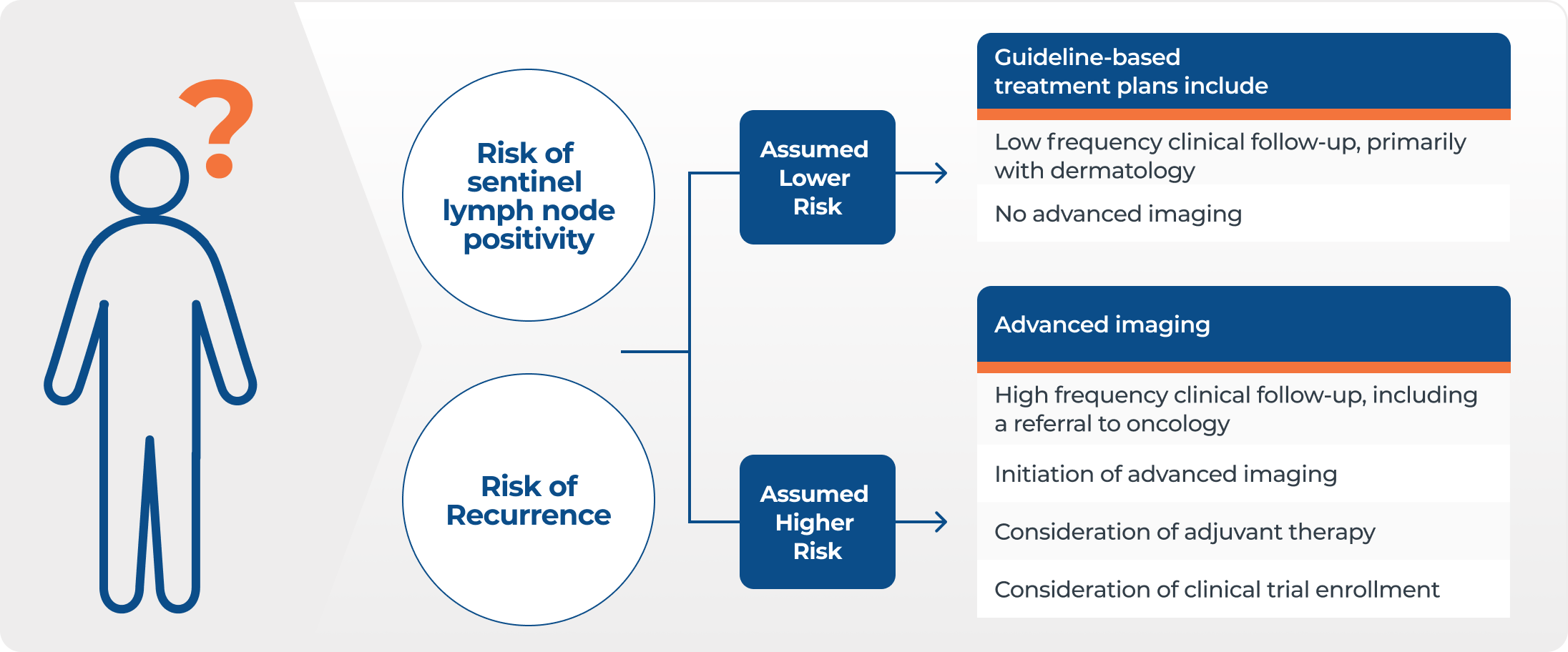
Gene Expression Profiling can also be used to rate how likely a melanoma is to spread after it’s been treated. While very thin melanomas can by ‘cured’ with simple removal; deep melanomas often require that the lymph nodes be checked (sentinel lymph node biopsy) and removed if positive. But what about the ‘in between’ melanomas? A certain percentage of the 60,000 patients diagnosed with early stage melanoma each year will see their melanoma spread at some point after the original melanoma is removed.
Traditional staging of a melanoma deeper than 0.75-1.0mm requires checking the lymph nodes with a procedure called sentinel lymph node biopsy. A positive sentinel lymph node biopsy (SLNB+) result upstages a patient from Stage I or II to Stage III. While Stage III patients have the highest risk for their melanomas spreading, about 2 out of every 3 patients that have melanoma spread are Stage I or II, including those who had a SLNB with a negative result.
Gene Expression Profiling can help us determine how likely it is for a melanoma to spread after surgical removal. This is important because if you have a high risk melanoma, you may need to have a body scan exam with CT (computed tomography) or PET (positron emission tomography) scans.